
Ninth-warmest August on record in U.S.: NOAA
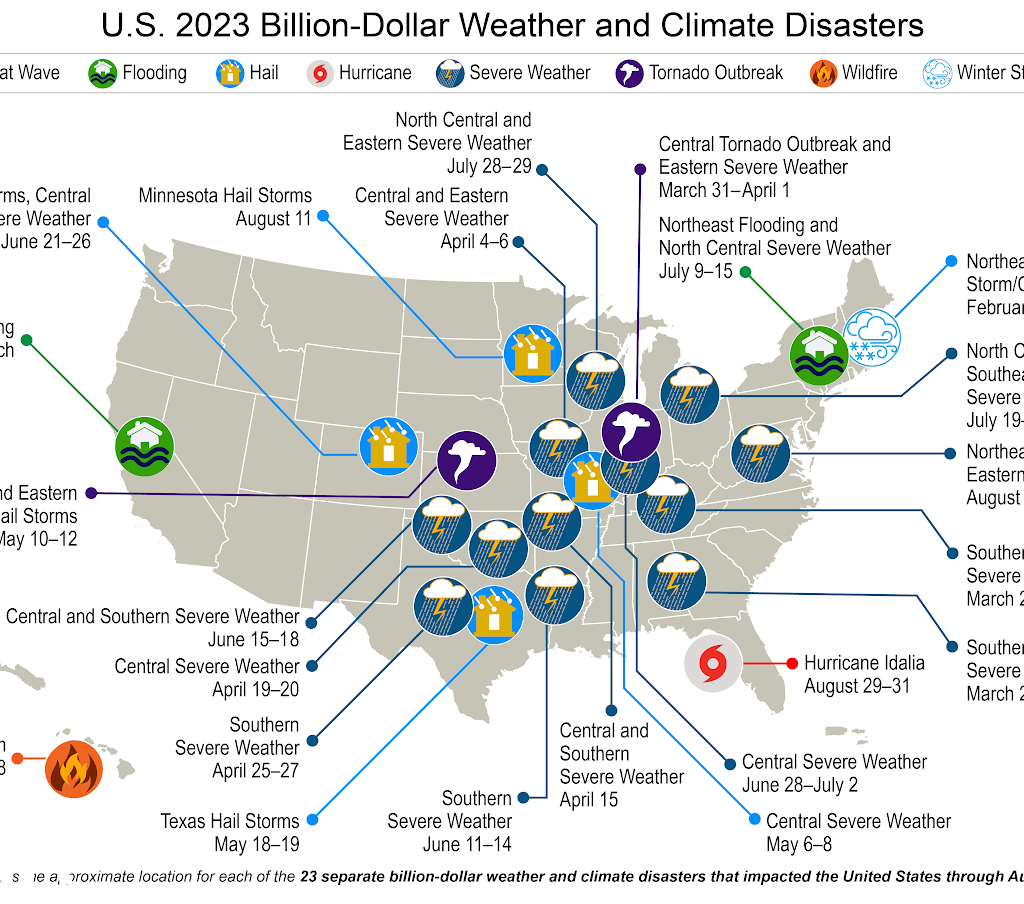
A map of the U.S. plotted with 23 weather and climate disasters each costing $1 billion or more that occurred between January and August, 2023. (Image credit: NOAA/NCEI)
NOAA – A warm August wrapped up a sweltering summer across the U.S., according to the National Oceanic and Atmospheric Administration’s (NOAA) National Centers for Environmental Information (NCEI).
The average temperature for August across the contiguous U.S. was 23.6 degrees Celsius — 1.3 degrees above average — ranking as the ninth-warmest August in the 129-year record. Florida, Louisiana and Mississippi all sizzled through their hottest Augusts on record, while Texas saw its second-hottest August. Alaska, whose climate record goes back 99 years, had its third-warmest August on record.
The average precipitation for August in the contiguous U.S. was 69.6 millimetres (3.05 mm above average), ranking in the middle third of the climate record. Precipitation extremes varied across the Lower 48, with California and Nevada seeing their second-wettest August on record and eight additional states having a top-10 wettest August. On the flip side, Louisiana had its driest August on record, while Mississippi and Texas had an August that ranked among their top-10 driest.
For meteorological summer (June 1 through Aug. 31), the average temperature for the contiguous U.S. was 22.8 C — 0.9 degrees above average — ranking as the nation’s 15th-hottest summer on record. Louisiana baked under its warmest summer on record, while Texas and Florida each saw their second-warmest summers. Four other states also saw their top-10 warmest summers on record.
The summer precipitation total across the contiguous U.S. was 212.1 mm — 0.76 of a mm above average — ranking in the middle third of the historical summer record. New Mexico and Louisiana each ranked third driest while four other states also had a top-10 driest summer. New Hampshire, Vermont and Wyoming ranked wettest on record, while five other states ranked among their top-10 wettest summers.
The average U.S. temperature for the first eight months of 2023 was 13.1 C — one degree above the 20th-century average — ranking as the 13th-warmest such year-to-date (YTD) in the climate record. Florida, Louisiana and Mississippi ranked warmest on record while five other states ranked second warmest for the January to August period.
The nation had 538.2 mm of precipitation for the YTD, 12.2 mm above average, ranking in the middle third of the January–August record. New Hampshire had its third-wettest such YTD on record, while Maryland saw its ninth driest.
According to the Aug. 29 U.S. Drought Monitor report, about 34.3 per cent of the contiguous U.S. was in drought, up about 6.2 points since the beginning of August. Moderate-to-exceptional drought was widespread across much of the Great Plains, while moderate-to-extreme drought covered the Northern Tier and Southwest.
The U.S. has been struck with a record-breaking 23 separate weather and climate disasters — each with losses exceeding US$1 billion — between January and August 2023. With approximately four months still left in the year, 2023 has already surpassed the previous record of 22 events seen in all of 2020. The 23 events include 18 severe weather events, two flooding events, one tropical cyclone (Hurricane Idalia), one wildfire event and one winter storm event.