
November 2020 the warmest November on record
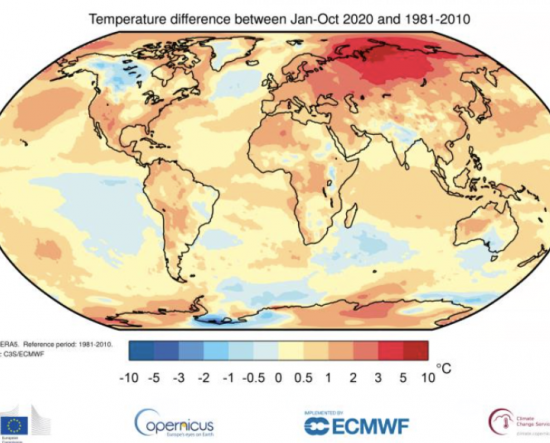

Surface air temperature anomaly for November 2020 relative to the November average for the period 1981-2010. Data source: ERA5. Credit: Copernicus Climate Change Service/ECMWF.
C3S – November 2020 was the warmest November on record, “by a clear margin”, according to data from the European Union’s Copernicus Climate Change Service (C3S).
Global mean temperatures were 0.77 degrees Celsius warmer than the 1981-2010 average for the month of November, and topped the previous records set in 2016 and 2019 by 0.13 C.
“These records are consistent with the long-term warming trend of the global climate,” said C3S director Carlo Buontempo, in an AlJazeera article.
“All policymakers who prioritise mitigating climate risks should see these records as alarm bells and consider more seriously than ever how to best comply with the international commitments set out in the 2015 Paris Agreement,” Buontempo added.
Temperatures were considerably higher than average over the Alps and the north of the European continent, according to the C3S report. Norway had its joint warmest November in a data series reaching back to 1900. Sweden and Finland also saw records broken. Conditions were close to or a little cooler than average only in parts of the south-east of the continent.
Temperatures were exceptionally high for November over a large region covering much of Siberia, the Arctic Ocean and bordering coastal seas, extending into western and northern Alaska and the far north-west of Canada. Temperatures were also substantially higher than average over the Tibetan Plateau and East Antarctica.
Heatwaves were experienced in parts of Australia during November 2020, and the month was the warmest November on record for the country as a whole. Heatwaves were also reported in Malawi and Mozambique, and it was generally warmer than average over much of southern, central and western Africa. Temperatures were also several degrees higher than normal east of the Andes, over a region stretching from Peru to Patagonia. Most of the United States and southern Canada were significantly milder than usual for late autumn, with many local temperature records broken in the central and eastern regions. Florida, New Mexico and Arizona experienced unusually high temperatures, states for which the January-to-October average temperatures for 2020 were the highest on record.
However, some areas were still cooler than average, despite the overall trend. Temperatures were below average over a region extending from the Central Asian Republics to Pakistan and northern India, by more than 5 C west of Lake Balkhash in Kazakhstan. It was also colder than usual by a similar amount over West Antartica. Temperatures were also below average over parts of Canada, Greenland and North Africa, and over coastal Brazil and the far south-west of Australia.
Air temperatures remained relatively high over the North Pacific Ocean and off the eastern seaboard of North America. Marine air temperatures were also well above average east of Argentina, and also above average over most of the Indian Ocean, the western Pacific and around most of Australia. Relatively cool La Niña conditions persisted over the tropical eastern Pacific, and temperatures were below average in several places over the extratropical oceans of the Southern Hemisphere and over part of the North Atlantic.