Ocean conference ends with call to action
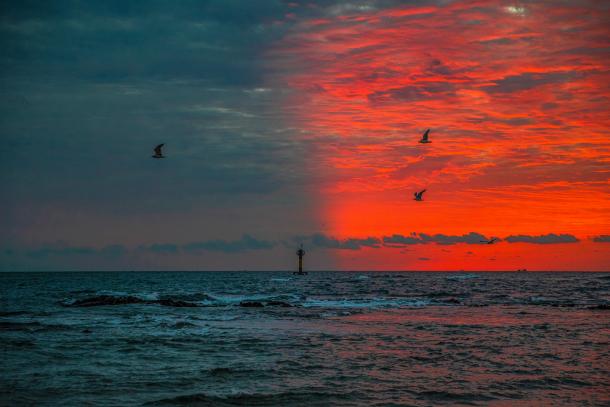
Photo by Kim Seungjin, Republic of Korea.
WMO – The week-long United Nations Ocean Conference concluded on July 1, with the unanimous adoption of the Lisbon Declaration “Our ocean, our future, our responsibility,” and firm commitments supporting innovative science-based actions to save our ocean and action against plastic pollution. More than 6,000 participants, including 24 heads of state and government and over 2,000 representatives from other organizations attended, including a senior delegation from the World Meteorological Organization (WMO).
Climate change is inflicting a devastating toll on the world’s oceans. Record ocean heat, acidification and de-oxygenation have major implications for marine life, ecosystems, food security and socio-economic development.
“There is no way to deal with the climate problem without the ocean, and no way to deal with the ocean problem without the climate,” said John Kerry, United States Special Presidential Envoy for Climate.
Speaking at an Interactive Dialogue on ocean acidification, deoxygenation and ocean warming on June 29, Kerry said that the rate of change was “alarming even the most neutral scientists.”
“These consequences will affect every single human being on the planet,” he stressed.
The theme of the Lisbon Conference was, “scaling up ocean action based on science and innovation for the implementation of Goal 14: stocktaking, partnerships and solutions.” This is in line with the UN Decade of Ocean Science for Sustainable Development, which stresses the critical need for scientific knowledge and marine technology to build ocean resilience.
According to the WMO’s State of the Global Climate in 2021 report, sea level rise, ocean heat, ocean acidification and greenhouse gas concentrations set new records in 2021.
The upper two kilometres of the ocean continued to warm in 2021 and it is expected that it will continue to warm in the future – a change which is irreversible on centennial to millennial time scales. Ocean warming rates show a particularly strong increase in the past two decades. The warmth is penetrating to ever deeper levels. Much of the ocean experienced at least one ‘strong’ marine heatwave at some point in 2021, which affects marine life and ecosystems, WMO Director of Services Dr. Johan Stander told the panel session.
Global mean sea level reached a new record high in 2021, after increasing at an average 4.5 millimetres per year over the period 2013 to 2021. This is more than double the rate of between 1993 and 2002 and is mainly due to the accelerated loss of ice mass from the ice sheets. This has major implications for hundreds of millions of coastal dwellers and increases vulnerability to tropical cyclones, he said.
Ocean acidification, which threatens organisms and ecosystem services, and hence food security, tourism and coastal protection. As the pH of the ocean decreases, its capacity to absorb CO2 from the atmosphere also declines.
The Intergovernmental Panel on Climate Change’s recent report concluded “there is very high confidence that open ocean surface pH is now the lowest it has been for at least 26,000 years and current rates of pH change are unprecedented since at least that time.”
Stander stressed the urgent need for enhancing and sustaining ocean observations. There are significant global coverage gaps in the observing network, with many under-sampled areas.
“We need more data. WMO is working hardly on improving the availability and accessibility of data that are needed to improve our understanding of the complex processes. We cannot take action if we do not understand the problem. We cannot understand what we cannot measure,” Stander emphasized.
Polar science and services
A WMO side event ‘Polar Regions in a changing climate: ocean solutions through science to services’, emphasised the concern regarding rapid changes in these fragile regions, where warming ocean temperatures are having pronounced impacts on ice cover.
Panelists from Argentina, Canada, Finland, and the U.S. discussed the vulnerabilities of these regions, and how science, research and Indigenous knowledge are all key to improving modelling of changes at multiple timescales, from days to seasons to years.
Dr. Anthony Rea, WMO Director of Infrastructure, called for collaboration and coordination for increased observations, which will provide the critical data, for improved forecasts and early warnings to protect people, ecosystems and property along the coast and at sea.