Prairie drought conditions show slight improvement: AAFC
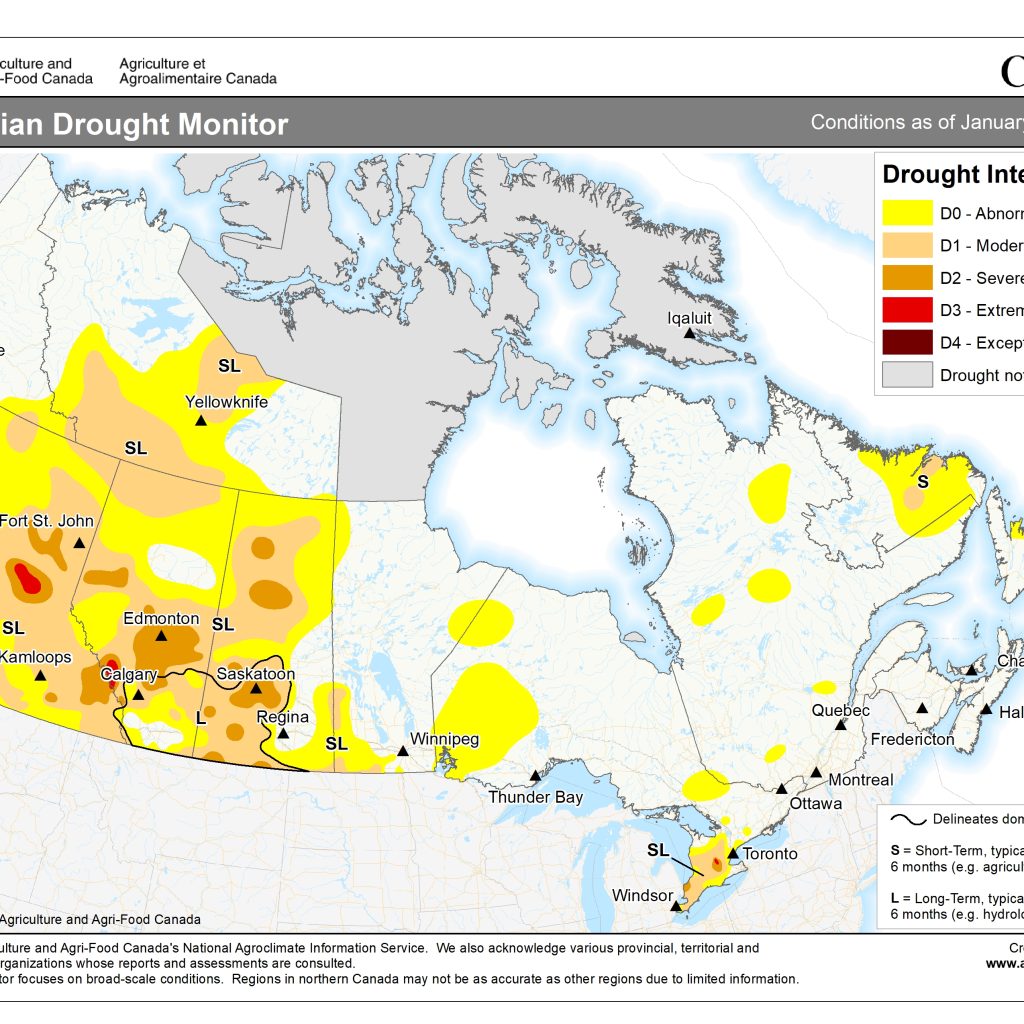
AAFC – Drought conditions improved slightly across the Canadian Prairies in January, according to the latest drought monitor report from Agriculture and Agri-Food Canada.
Snowpack remained low across much of Western Canada resulting in concerns for limited spring runoff, especially in British Columbia and parts of Alberta, according to the report. Winter precipitation in the Prairie region to date was near- to above-normal in areas that were dry going into the winter. However, long-term indicators continued to improve despite the lower-than-normal precipitation in January, resulting in reduced drought severity in some regions.
January brought above-average temperatures and below-normal precipitation across much of the Prairie Region, according to the report. Southern Manitoba as well as central Alberta and parts of south and central Saskatchewan received the least amount of precipitation during the month, while remaining areas received near- to slightly below-normal accumulations. So far this winter, precipitation has been near- to above-normal across southern and central Alberta as well as much of western and central Saskatchewan, while northeastern Alberta and southeastern Saskatchewan were drier than normal.
In contrast, winter precipitation across southern Manitoba was below normal with most of the area reporting significant deficits. Although these deficits have been quite low throughout the winter, drought degradation was minimal this month due to limited average seasonal precipitation in addition to good soil moisture and water supplies going into the winter.
Changes during the month included improvements to Severe Drought (D2) in southern Saskatchewan as well as the removal of Extreme Drought (D3) around Saskatoon. There was a minor shift to the Severe Drought (D3) in central Alberta, but much of the D3 remained. Extreme Drought (D3) along the Rockies also remained in place due to continued dry conditions this month. Although winter precipitation improved throughout the winter, many parts of Alberta would benefit from continued precipitation to make up for the well below-normal soil moisture reserves and depleted surface water supplies in the fall. In Manitoba, there was a minor expansion of Abnormally Dry (D0) and Moderate Drought (D1) in southern areas due to dry conditions in the last 3 to 6 months.
An estimated 66 per cent of the Prairies was classified as abnormally dry or in moderate to severe drought as of Jan. 31, 2023, including 80 per cent of agricultural areas, according to the report.