Precipitation does little to change drought outlook
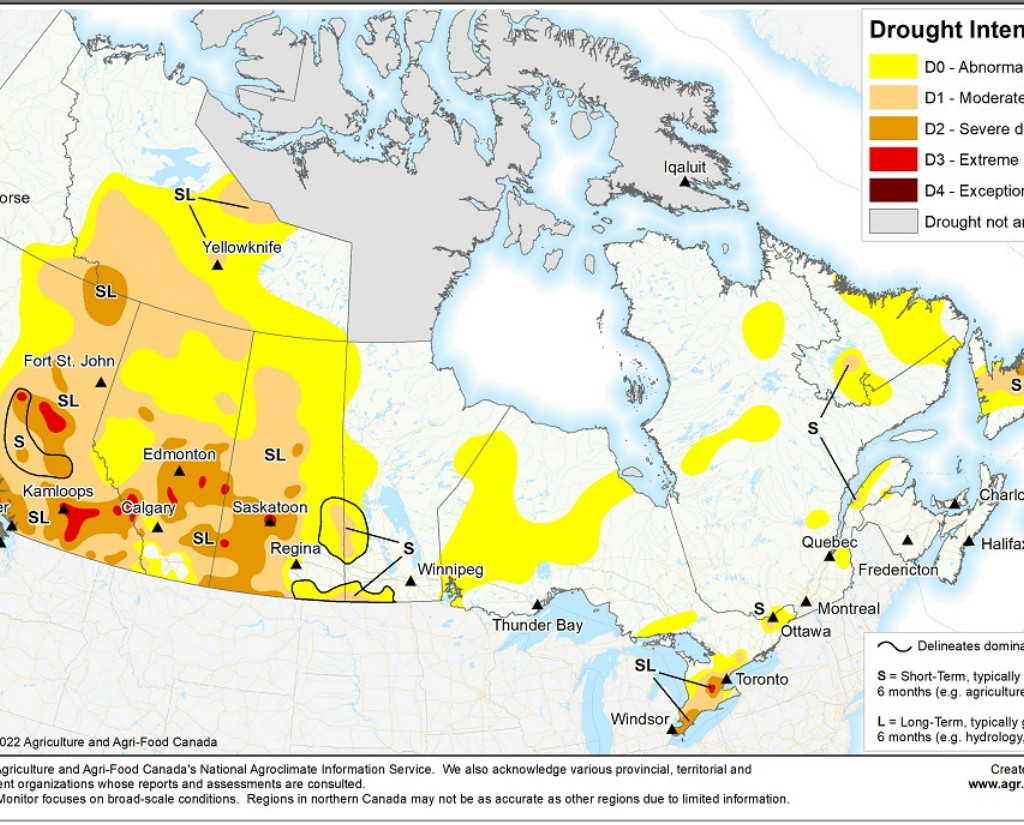
Map of drought conditions across Canada as of Nov. 30, 2022. Photo credit: Agriculture and Agri-Food Canada.
By Adam Peleshaty and MarketsFarm
WINNIPEG – The Prairies received above-average amounts of precipitation during the month of November, but they did not alleviate drought conditions according to Agriculture and Agri-Food Canada’s (AAFC) Canadian Drought Monitor.
As of Nov. 30, 72 per cent of the Prairies was rated from Abnormally Dry (D0) to Extreme Drought (D3), which included 80 per cent of the region’s agricultural landscape. Nearly the entirety of both Alberta and Saskatchewan were affected by abnormally dry conditions or worse. There were no areas under exceptional drought (D4).
Small pockets of extreme drought were found near Vegreville, Red Deer, Lloydminster and Banff, but much of Alberta was under moderate to severe drought (D1 to D2). Moderately high to very high precipitation fell onto the province in November, except in the Peace region which received lower-than-normal amounts. However, precipitation since September has been below normal across Alberta. Some areas of the Peace region and northern Alberta shifted from D0 to D1.
Saskatchewan also received above-normal amounts of precipitation with the central part of the province getting between 150 to more than 200 per cent the normal amount for November, which only accounted for five to 25 millimetres. Parts of southwestern and west-central Saskatchewan have seen 110 to 140 mm less precipitation than normal in the last year. Most moderate to extreme drought (D1 to D3) are still in place, including a pocket of extreme drought in Saskatoon, but conditions near Swift Current have been upgraded from D3 to D2.
In Manitoba, only parts of the southwest and areas along the Saskatchewan border are abnormally dry or worse. Farmlands in Manitoba received below-normal precipitation in November, but the only areas under D1 are around Swan River and Melita. Conditions in those areas are only expected to last in the short-term.