Record breaking heat, humidity for tropics
Potentially harmful, fatal for humans
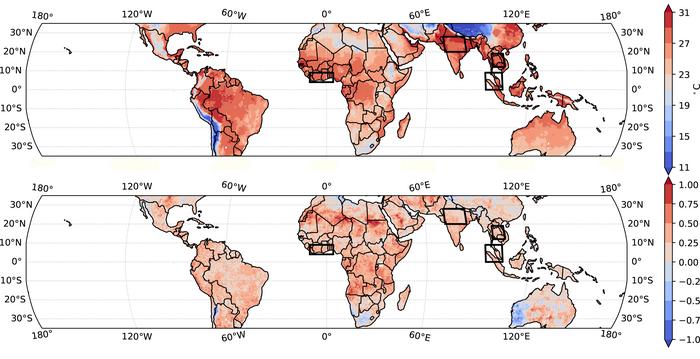
Maps of the tropics showing the annual maximum wet-bulb temperatures predicted by the authors for the upcoming summer, taking into account current El Niño conditions and global warming (top) and the incremental effect due to El Niño alone (bottom). The reddest areas are predicted to have the highest wet bulb temperatures — a measure of the combined effects of humidity and temperature. The black boxes outline regions that were analyzed in more detail. (Yi Zhang, UC Berkeley)
University of California – Berkeley (WeatherFarm) – A new statistical analysis of the interaction between El Niño and rising global temperatures due to climate change concluded that the approaching summer in the tropics has nearly a seven in 10 chance of breaking records for temperature and humidity.
The prediction, by climate scientists at the University of California – Berkeley, was applied to a broad swath of the world straddling the equator, including India, plus the bulk of Africa, Central and South America, along with Australia, Florida and Texas.
Long-term predictions like this can help regions prepare for extreme heat events and protect humans, livestock and crops, said Prof. William Boos, one of the authors of the study.
“Humanitarian aid and outreach, preparation for medical care and advising and distribution of crops and agricultural equipment can all be adjusted in ways that can account for that prediction,” Boos said.
While temperatures around the globe have been setting records nearly every year, the combination of high heat and high humidity is a double whammy that can be deadly. While most healthy people can handle a dry heat, humid heat is much more stressful for the body. The more humid it is, the less sweat evaporates, which reduces sweating’s cooling effect and makes it harder to keep the body’s core temperature within normal range.
“If you can’t cool your body to below 37 degrees Celsius, then you’ll die,” Boos said. “Sweat is the main way we have to cool ourselves when it gets hot. So if sweating will not allow you to cool below your core body temperature, that’s the survivability limit.”
The prediction is based on scientists’ current understanding of El Niño’s impact on tropical heat and humidity, in particular, that atmospheric temperatures several kilometers above the ground control how hot and humid it can get at ground level. These upper-level temperatures are at their warmest about five months after El Niño peaks. The most recent peak occurred in December 2023.
“It’s commonly known that the Earth is warming, and El Niño is a warm episode of a natural climate oscillation, so we expect the two to constructively interfere — that El Niño will compound the effects of global warming,” Boos said. “Over the long term, global warming brings increased temperature, as well as increased humidity — that is, increased water vapor content of the air. Together with El Niño, this allows the heat and humidity to build up to greater levels at a given location in the tropics.”
The researchers concluded from their analysis that the “strong‐to‐very‐strong El Niño” at the end of 2023, which was rated a 2.0 on the Oceanic Niño Index, suggests a 2024 tropical land mean maximum wet bulb temperature of 26.2 C and a 68 per cent chance of breaking existing records. The wet bulb temperature — basically the temperature you can maintain when covered in sweat or a wet T-shirt in the presence of a strong wind — is a better indication than temperature alone of how humans feel under humid heat conditions. In warm-humid environments like the tropics, wet bulb temperatures above 30 C could lead to irreversible heat stress.
According to Boos, some areas that frequently suffer under humid heat stress, such as northern India, have a 50 per cent chance of suffering record heat and humidity this summer. The Sahel region in Africa, however, has a 35 per cent chance of record humid heat.