Safe planetary boundary for pollutants exceeded: researchers
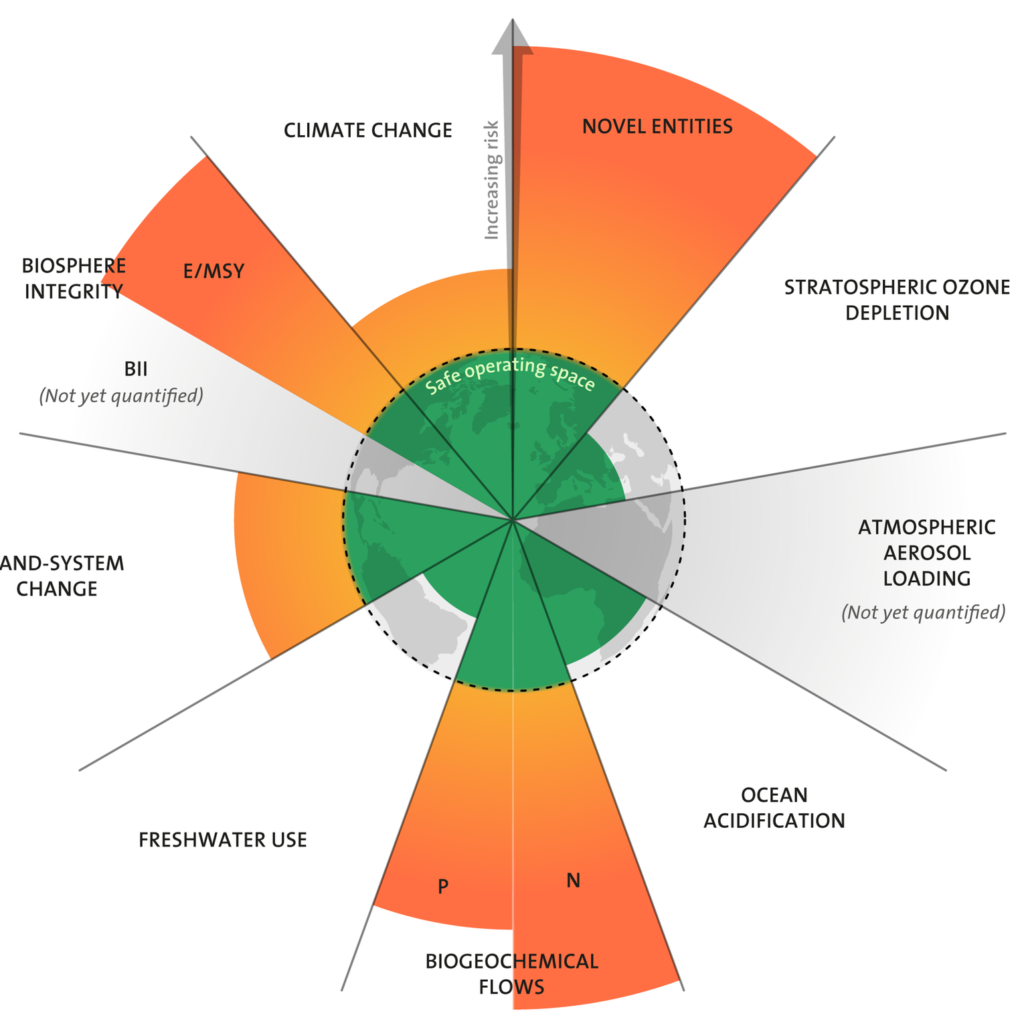
Planetary boundaries. (Source: Stockholm Resilience Centre.)
Stockholm Resilience Centre – Humanity has exceeded a planetary boundary on environmental pollutants, according to a study published in the journal Environmental Science and Technology that assessed the impact of the stability of the Earth system on a cocktail of synthetic chemicals and other “novel entities” flooding the environment.
“There has been a 50-fold increase in the production of chemicals since 1950. This is projected to triple again by 2050,” co-author Patricia Villarubia-Gómez from the Stockholm Resilience Centre said.
Plastic production alone increased 79 per cent between 2000 and 2015, the team reports.
“The pace that societies are producing and releasing new chemicals and other novel entities into the environment is not consistent with staying within a safe operating space for humanity,” she added.
Fills important gap in research
There are an estimated 350,000 different types of manufactured chemicals on the global market. These include plastics, pesticides, industrial chemicals, chemicals in consumer products, antibiotics and other pharmaceuticals. These are all wholly novel entities, created by human activities with largely unknown effects on the Earth system. Significant volumes of these novel entities enter the environment each year.
“The rate at which these pollutants are appearing in the environment far exceeds the capacity of governments to assess global and regional risks, let alone control any potential problems,” co-author Bethanie Carney Almroth from the University of Gothenburg said.
The research fills an important gap in analysis of “planetary boundaries”.
In 2009, an international team of researchers identified nine planetary boundaries that demarcate the remarkably stable state Earth has remained within for 10,000 years – since the dawn of civilization. These boundaries include greenhouse gas emissions, the ozone layer, forests, freshwater and biodiversity. The researchers quantified the boundaries that influence Earth’s stability, and concluded in 2015 that four boundaries have been breached. But the boundary for novel entities was one of two boundaries that remained unquantified.
This new research takes this a step further.
Overwhelming evidence
The researchers say there are many ways that chemicals and plastics have negative effects on planetary health, from mining, fracking and drilling to extract raw materials to production and waste management.
“Some of these pollutants can be found globally, from the Arctic to Antarctica, and can be extremely persistent. We have overwhelming evidence of negative impacts on Earth systems, including biodiversity and biogeochemical cycles,” Carney Almroth said.
Global production and consumption of novel entities is set to continue to grow. The total mass of plastics on the planet is now over twice the mass of all living mammals, and roughly 80 per cent of all plastics ever produced remain in the environment.
Plastics contain over 10,000 other chemicals, so their environmental degradation creates new combinations of materials – and unprecedented environmental hazards. Production of plastics is set to increase and predictions indicate that the release of plastic pollution to the environment will rise too, despite huge efforts in many countries to reduce waste.
Shifting to circular economy
The researchers conclude that current increasing trends of chemical production and release put the health of the Earth system at risk. The authors call for actions to reduce the production and release of pollutants.
“We need to be working towards implementing a fixed cap on chemical production and release,” Carney Almroth added.
“And shifting to a circular economy is really important. That means changing materials and products so they can be reused not wasted, designing chemicals and products for recycling, and much better screening of chemicals for their safety and sustainability along their whole impact pathway in the Earth system”, Sarah Cornell, also from the Stockholm Resilience Centre explained.