
Sea ice ecosystem threatened by climate change
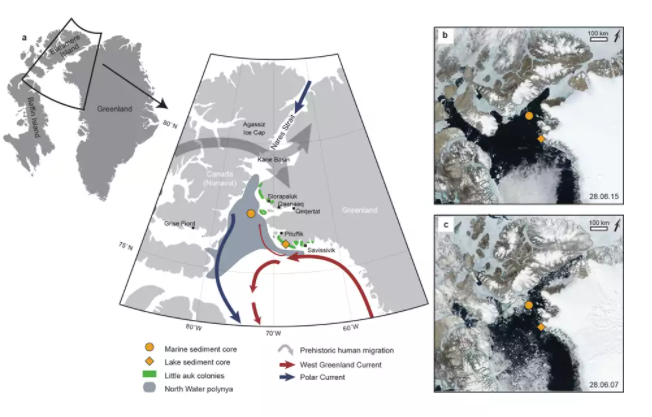
The North Water polynya is a biological hotspot and has been the prehistoric gateway to Greenland. Credit: Ribeiro et al. 2021
GEUS – When humans first arrived in Greenland more than 4,000 years ago, they may have crossed an oasis in the middle of the sea ice as they made their way from Canada and across the Nares Strait.
This oasis, known as the North Water polynya, is an area of open water that forms in an otherwise barren environment. Polynyas form only at certain times of the year and at certain latitudes where sea ice normally prevails. Today, the North Water polynya provides a waterway to several Indigenous communities and key Arctic species. But it is very vulnerable to climate warming and thinning of sea ice.
A new study published in Nature Communications now reveals a 6,000-year history of the North Water polynya and reveals how periods of relative stability coincide with the history of human settlement in the region.
“Our study uses many lines of evidence and reveals a stable, biological oasis around 4,400 to 4,200 years ago, when the first humans arrived in Greenland,” said lead author Sofia Ribeiro, senior scientist at the Geological Survey of Denmark and Greenland (GEUS).
A mystery gap explained
The new study combines a range of innovative analyses of marine and freshwater sediments to track over 6,000 years of variation in the stability and productivity in and around this unique and globally important Arctic ecosystem.
Scientists now know the likely date of genesis of the North Water polynya was around 4,400 years ago – coincident with the first recorded arrival of humans in Greenland.
However, at other times, climate warming led to instability and even a collapse of the Polynya for up to 1,000 years.
“Climate forcing during warm periods led to polynya instability and a collapse of productivity from around 2,200 to 1,200 years ago,” says Ribeiro. “This overlaps with this so-called ‘mystery gap’ – a time when archaeological studies point to Greenland being uninhabited.”
The resistance and resilience of this delicate balance in the North Water polynya over the past 6,000 years may shed light on how it may behave in the face of current climate warming.
A foreshadow of future instability
Polynyas in general and the North Water in particular, are biological hotspots, supporting a rich variety of marine mammals and seabirds. The name, North Water, originates from the 18th Century whalers. The region has a long history of colonisation as the main route for various waves of human migration into Greenland over the past 4,400 years.
Polynyas provide a refuge for many species in the otherwise barren polar environment, Ribeiro said.
But declining sea ice due to present-day climate warming has led to recent instability of the North Water Polynya formation.
“The existence and persistence of the polynya rely on a delicate balance of several factors including landscape and oceanographic morphology, ocean currents and upwelling, prevailing winds, temperature and perhaps internal feedbacks,” Ribeiro said.
“Air temperatures in the region are at their highest in the history of the North Water, and human-made warming will continue to lead to sea ice thinning and loss in the Arctic. This is very bad news for ice-arch stability and polynya formation,” she said.
The new study shows how this important Arctic ecosystem has waxed and waned in response to past climate change. In doing so, it is expected to provide crucial information to understand the vulnerability and provide guidance to secure the resilience of both ecosystems and people in the rapidly warming Arctic.