
Sixth-warmest autumn on record for U.S.
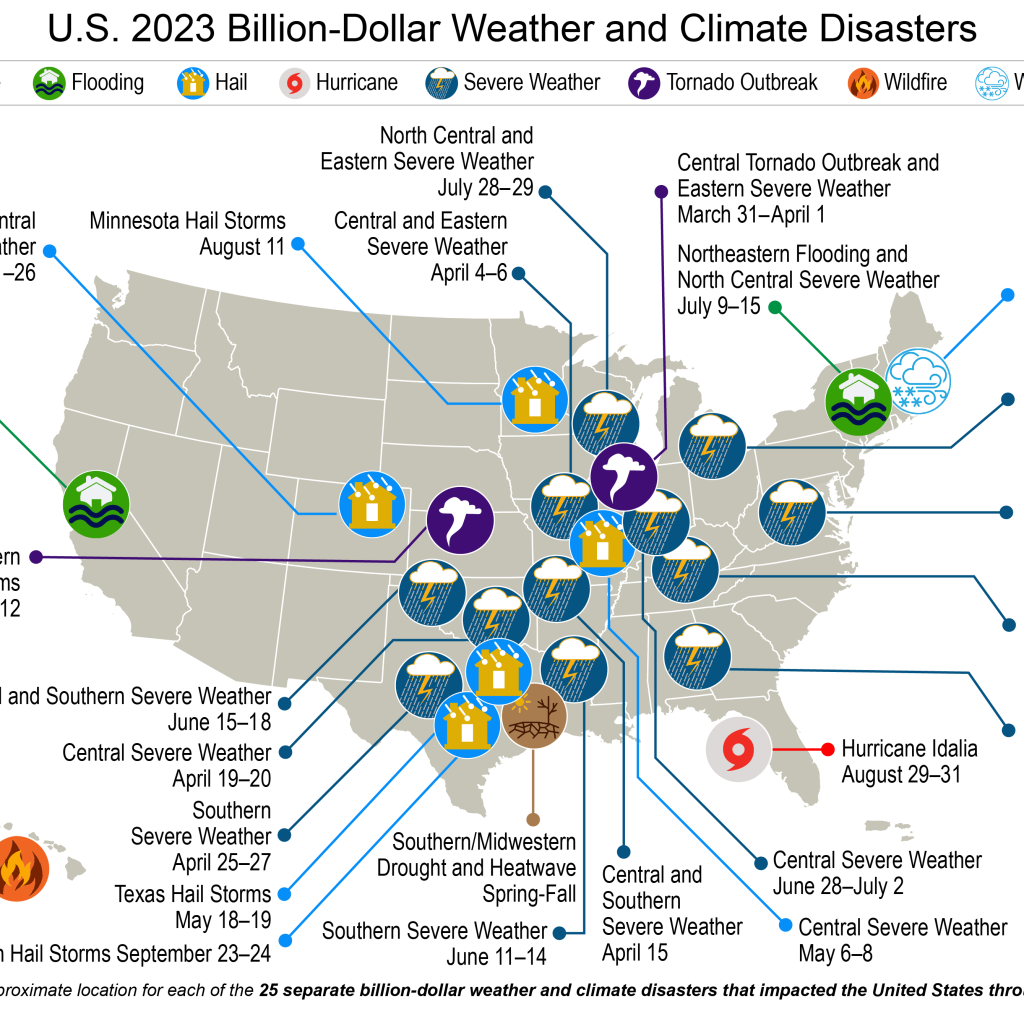
A map of the U.S. plotted with 25 weather and climate disasters each costing $1 billion or more that occurred between January and November, 2023. (Image credit: NOAA/NCEI)
NOAA – Last month wrapped up a remarkably warm meteorological autumn across the United States, with the season ranking as the sixth-warmest autumn on record for the nation, according to scientists from National Oceanic and Atmospheric Administration’s (NOAA) National Centers for Environmental Information (NCEI).
A busy Atlantic hurricane season also came to a close, ranking fourth for the most-named storms in a year since 1950.
The average November temperature across the contiguous U.S. was 6.9 degrees Celsius (1.5 C above average), ranking as the 19th-warmest November in NOAA’s 129-year climate record.
November temperatures were above average across much of the U.S., while below-normal temperatures were observed in parts of the Northeast. No state in the contiguous U.S. saw its top-10 warmest or coldest November on record. However, Alaska saw its fourth-warmest November in the 99-year period of record for the state.
The nation’s average precipitation across the contiguous U.S was 35.05 millimetres (21.6 mm below average), ranking as the 12th-driest November on record. Indiana saw its third-driest November on record, while Illinois, Kentucky, Missouri and Wisconsin all saw a top-10 driest November. No state saw a top-10 wettest November.
It was an exceedingly warm meteorological autumn (September through November) across the contiguous U.S. The average autumn temperature was 13.4 C (1.4 C above average), ranking as the sixth-warmest autumn on record.
New Mexico and Texas saw their third-warmest autumns on record, while Maine saw its fourth warmest. Arizona, Colorado, Massachusetts, Minnesota, Montana, Nebraska, New Hampshire, Vermont, Wisconsin and Wyoming all had their top-10 warmest autumn.
The total autumn precipitation across the U.S. was 143.8 mm (31 below average), which ranked as the 15th-driest autumn on record. Tennessee’s autumn ranked as third driest, with three additional states — Indiana, Kentucky and Mississippi — seeing their top-10 driest autumn. No state ranked in their top-10 wettest on record for the September to November period.
With just one month to go in 2023, the year-to-date (YTD) average temperature across the contiguous U.S. was 13.2 C — 1.1 C above average — ranking as the 10th-warmest such YTD in the record.
Louisiana, Mississippi and Texas each ranked warmest on record, while Connecticut, Florida and Massachusetts each ranked second warmest for the January–November period.
The YTD precipitation total for the contiguous U.S. was 683 mm, 17.8 below average, ranking in the driest third of the historical record.
Louisiana and Maryland ranked seventh and eighth driest on record, respectively, for this YTD period. Meanwhile, Wyoming ranked seventh wettest on record, while Maine, Nevada, New Hampshire and Vermont all saw their top-10 wettest such YTD.
According to the Nov. 28 U.S. Drought Monitor report, about 36.1 per cent of the contiguous U.S. was in drought, down about 0.4 per cent from the end of October. Moderate-to-exceptional drought was widespread across much of the Lower Mississippi Valley, Tennessee Valley, central Great Plains and Southwest, with moderate-to-extreme drought over parts of the southern Great Plains, Hawaii and across parts of the Florida Peninsula. Moderate-to-severe drought was present in parts of the Northwest, Mid-Atlantic and New York.