Smoky conditions to persist in coming years: study
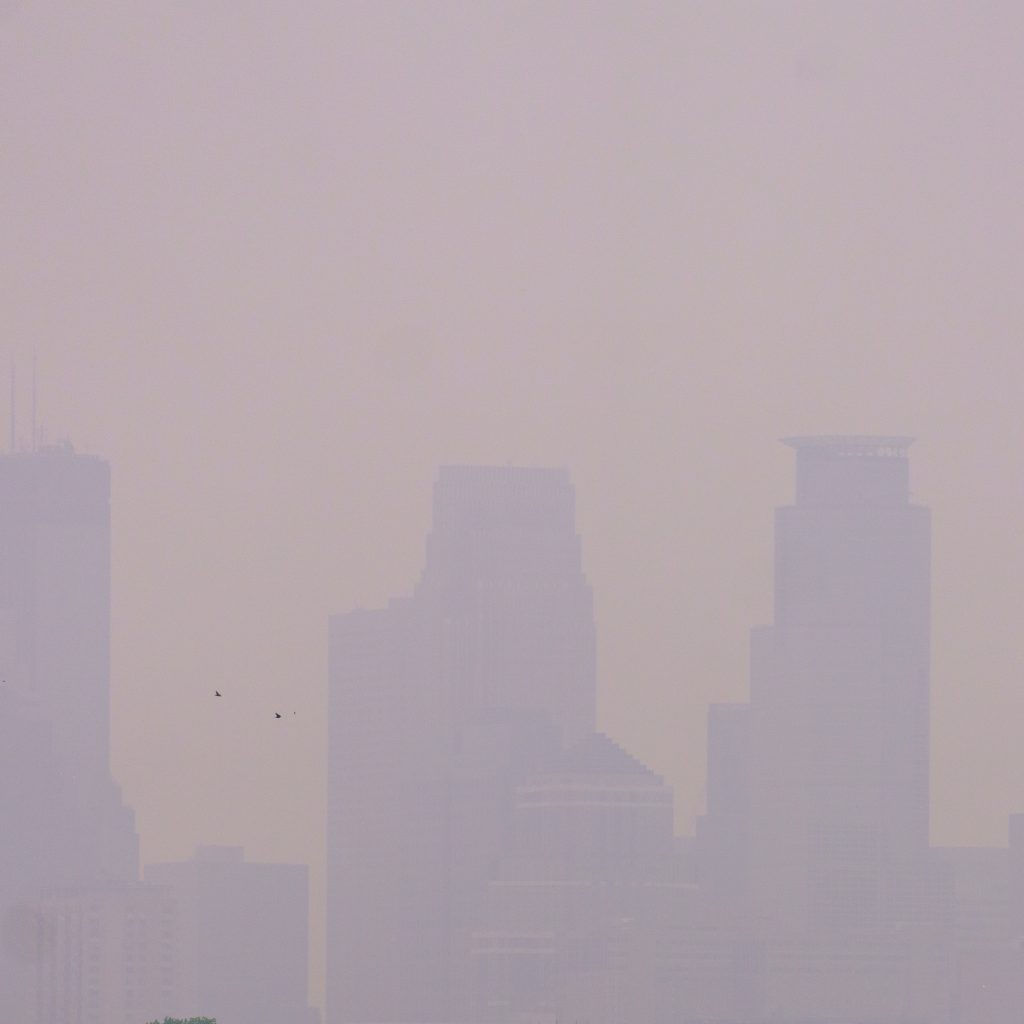
Canadian wildfire smoke hits Minneapolis today prompting air quality warnings. Credit: Chad Davis via Wikimedia Commons
Canadian wildfire smoke hits Minneapolis, prompting air quality warnings. Credit: Chad Davis via Wikimedia Commons
Columbia Climate School – Canada’s record-breaking wildfires, which spread smoke across North America in 2023, were a precursor to a smokier future, said a recently published study.
Researchers from Columbia University in New York City found that warmer, drier summers in Canada will increase the chances of fires, and therefore, smoke in the air. They reviewed climate projections which were found to correlate with increases in burned area over the past decade.
However, Western Canada is likely to see more of the effects of wildfires than in the other parts of the country.
“What we found is a big east-to-west shift,” said lead author Robert D. Field, an associate research scientist at the NASA Goddard Institute for Space Studies, part of the Columbia Climate School. “Air quality improved in the east as industrial emissions dropped, and at the same time it degraded in the west because of more fire.”
The study drew on a large set of long-term data to analyze smoke in Canada, including atmospheric measurements from five satellite instruments beginning in 2001, weather station reports of “smoke” and “haze” dating to 1953, and national records of burned areas since 1959.
Together, these records showed that 2023 had the highest smoke levels in 20 years of satellite measurements and the most smoke and haze reports in seven decades of surface observations. Twelve out of Canada’s 13 provinces and territories set new records for wildfire smoke in 2023. Nearly 15 million hectares burned across the country, an area the size of New York State and more than twice the previous national record.
Preliminary updates showed that fires burned nearly five million hectares in 2024 and eight million hectares in 2025.
“We urgently need to develop cohesive policies, programs, and practices that protect people and populations from exposure to wildfire smoke in the United States, Canada and beyond,” said Sarah B. Henderson, scientific director of environmental health services at the British Columbia Centre for Disease Control.
The study was published in the journal Earth’s Future on Dec. 12, 2025.