Summer of 2022 was third-hottest on record: NOAA
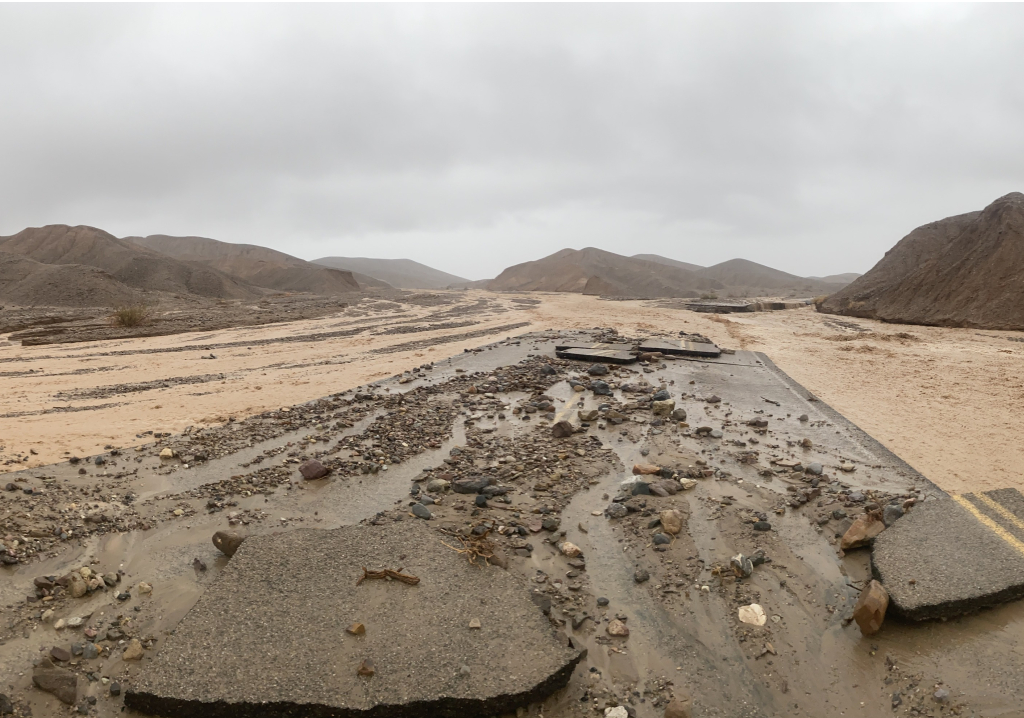
Photo of flood damage at Mud Canyon Road in Death Valley National Park, California, from August 2022. On August 5, 2022, the park received 1.70 inches of rain — an all-time 24-hour rainfall record for the area. (National Park Service)
NOAA – A top-10 warm August capped off a distinctly hot summer, as the United States saw its third-hottest meteorological summer on record.
Last month was also marked by several extreme rainfall events across the nation that resulted in historic flooding, according to National Oceanic and Atmospheric Administration’s (NOAA) National Centers for Environmental Information.
For meteorological summer (June 1 through Aug. 31), the average temperature for the contiguous U.S. was 73.9 degrees Fahrenheit, 2.5 degrees above average, ranking as the third-hottest summer in 128 years.
Summer temperatures were above average across most of the contiguous U.S. Massachusetts, Rhode Island and Texas each saw their second-warmest summer on record, while 17 additional states across the West, South and Northeast saw their top-10 warmest summer on record.
The summer precipitation total across the contiguous U.S. was 8.18 inches — 0.14 of an inch below average — ranking in the middle third in the historical summer record. Precipitation was above average along the West Coast, parts of the Southwest, Midwest, lower Mississippi Valley and northern New England. Meanwhile, precipitation was below average across the Great Plains and portions of the East Coast. Arizona had its seventh-wettest summer on record as Nebraska saw its third-driest summer.
The average temperature for August across the contiguous U.S. was 74.6 F, 2.5 degrees above average, and ranked as the eighth-warmest August on record. The contiguous U.S. monthly average minimum temperature was record-warm for the second month in a row during August. California, Idaho, Nevada, Oregon and Washington each ranked warmest on record for August nighttime temperatures.
The average precipitation for August in the contiguous U.S. was 3.04 in. (0.42 of an inch above average), ranking in the wettest third of the climate record. Extreme rainfall events during the month of August contributed substantially to the record-wet August for Mississippi — as well as the third-wettest August for Nevada and Louisiana. However, a few states stayed quite dry last month, with Nebraska seeing its second-driest August on record and Kansas seeing its seventh driest.
The average U.S. temperature for the first eight months of 2021 was 55.4 F — 1.5 degrees above the 20th-century average — ranking in the warmest third of the climate record. Florida had its fourth-warmest such year-to-date (YTD) on record and California saw its fifth-warmest.
The nation had 19.68 in. of precipitation for the YTD, 1.03 in. below average, ranking in the driest third of the January–August record. California ranked driest YTD on record, while Nebraska ranked fifth driest and Nevada ranked seventh driest for this YTD.
Several extreme 1,000-year flooding events occurred across the U.S. in August. On Aug. 2, parts of southern Illinois were drenched by eight to 12 in. of rain in a 12-hour period. An area south of Newton, Ill. recorded 14 in. of rainfall over the same period. On Aug. 5, Death Valley National Park received 1.7 in. of rain, an all-time 24-hour rainfall record for the area, resulting in substantial flooding and damage to roads and vehicles, temporarily stranding park visitors and staff overnight. On Aug. 22, some parts of Dallas, Texas, saw more than 13 in. of rainfall within 12 hours. Texas Gov. Greg Abbott declared a disaster for 23 Texas counties, including Dallas, after storms caused damage and devastating flash flooding.
Drought conditions improved overall: According to the August 30 U.S. Drought Monitor report, about 45.5 per cent of the contiguous U.S. was in drought, down about 5.9 per cent from the beginning of August. Drought conditions lessened or were eliminated across portions of the Southwest, southern Plains, central Mississippi Valley, Great Lakes, parts of the Northeast and Puerto Rico. Drought conditions expanded or intensified across portions of the Northeast, central and northern Plains, the Northwest and Hawaii.