
Summer storms stronger, more frequent over urban areas
Heavy, localized rainfall over urban areas could lead to increased flooding in cities
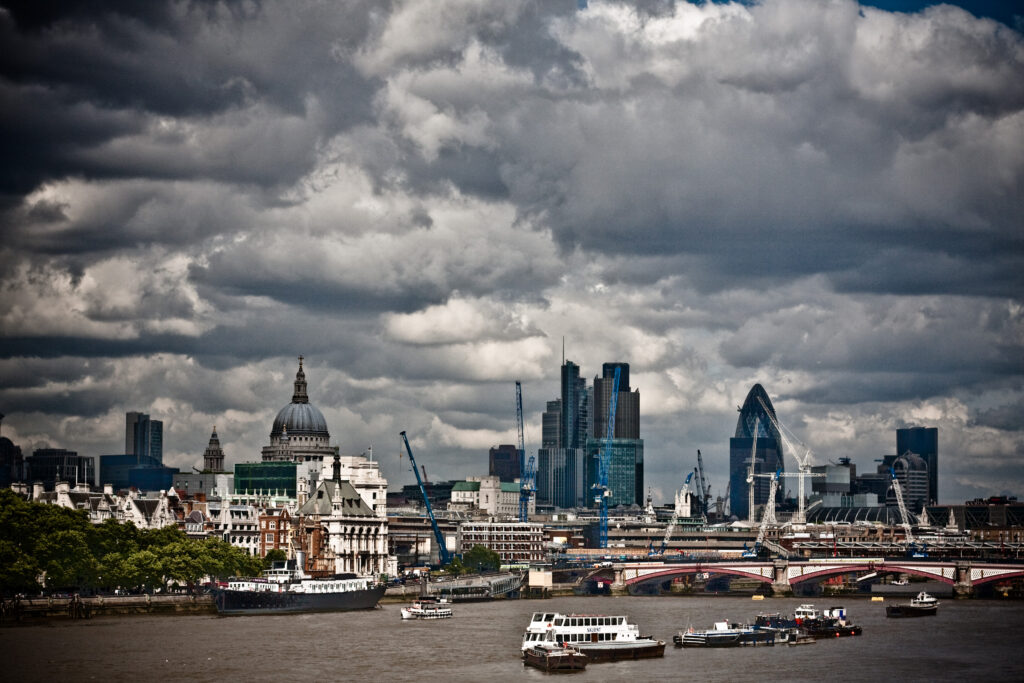
More storms form over cities and their boundaries than over rural areas. They also release more intense and concentrated rainfall, according to new research in Earth’s Future. Credit: Wikimedia Commons/Garry Knight/CCA BY-SA 2.0
American Geophysical Union (WeatherFarm) — Summer storms are generally more frequent, intense and concentrated over cities than over rural areas, according to new, detailed observations of eight cities and their surroundings. The results could change how city planners prepare for floods in their cities, especially as urban areas expand and as climate change alters global weather patterns.
The new study found more storms form over urban areas and their boundaries than in surrounding areas, and larger cities intensify rainfall more than smaller cities.
“Cities are expected to become more populated and increase in size in the coming decades,” said Herminia Torelló-Sentelles, an atmospheric scientist at the University of Lausanne and the study’s lead author. “Being able to quantify urban flood risk is important for urban planning and when designing urban drainage systems.”
The rain effect has been reported in studies of single cities, but the new research looked for trends and differences across multiple cities. Differences in urban rainfall patterns highlight the need to keep studying storm activity in cities across the globe, Torelló-Sentelles said.
Some storms have rain that falls evenly, like a sprinkler, while others drop rain in concentrated bursts, like a fire hose. The new study found that cities can turn storms into fire hoses, dropping bursts of rainfall over small urban areas instead of spreading out the rain over a larger area. Those concentrated bursts of rainfall can exacerbate flood risks if city infrastructure cannot handle the deluge.
“It’s not only intensity of rainfall that matters when you look at flood risk. It’s also how it’s distributed over space,” Torelló-Sentelles said. “If you have a very large amount of rainfall falling over a very small area, that can collapse the drainage system in an urban area.”
Several factors could be causing urban storm creation and intensification, Torelló-Sentelles said. Cities are generally warmer than their cool, moist and vegetation-dense surroundings, which could cause air to be drawn toward the cities and uplifted. That warm, uplifted air then condenses into rainclouds over urban centers.
Storms are also often formed as air is uplifted over mountain ranges, producing rain clouds at the mountains’ peaks. Like mini mountain ranges, city skylines can create favorable environments for the uplift of airmasses and the creation of storms. Aerosol pollution suspended in the atmosphere over cities may also either enhance or suppress rainfall.
The researchers used seven years of high-resolution weather data from eight cities in Europe (Milan, Berlin, London and Birmingham) and the United States (Phoenix, Charlotte, Atlanta, and Indianapolis) to track summer storm formation and intensity in cities and their surroundings. The cities varied in size, climate and urban shape, but all are in relatively flat regions and far from large bodies of water — factors which could influence local rainfall patterns.
The researchers tracked storm formation and evolution outside of and over cities and their boundaries, identifying the average direction, average intensity, maximum intensity and area of each storm. They found that more storms overall formed over cities and their boundaries compared to nearby rural areas.
Storms typically were most intense over city centers, or over the city edges as in Berlin and Birmingham. Larger cities had greater rainfall intensification than smaller cities: in smaller cities, rainfall intensified by 0.9 to 3.4 per cent, while it increased from 5.2 to 11 per cent in the largest cities compared to outlying areas. Some cities also had much higher rainfall intensification during specific times of the day.
Rainfall also became more spatially concentrated over urban areas by up to 15 per cent. Concentrated bursts of rainfall can tax urban water management systems more than rainfall that is evenly distributed.