
U.K. peatland fires intensifying climate change
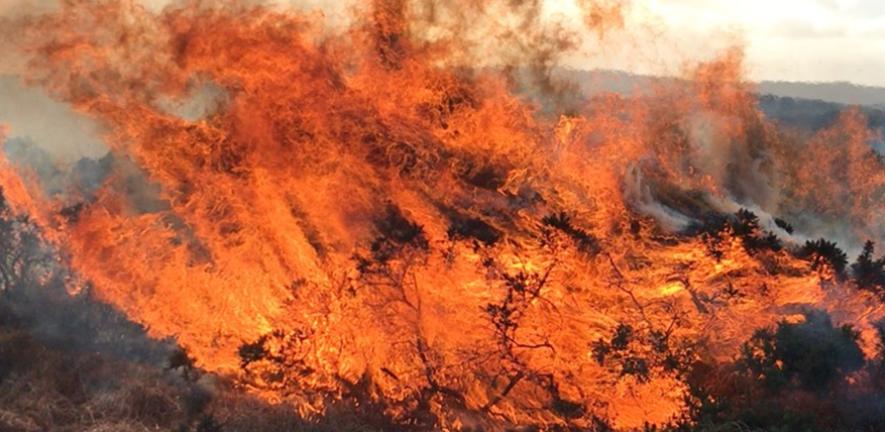
Fire on U.K. moorland. Credit: Sarah Baker/Creative Commons
University of Cambridge — A new study led by the University of Cambridge has revealed that as springs and summers in the United Kingdom get hotter and drier, the U.K. wildfire season is being stretched and intensified.
More fires, taking hold over more months of the year, are causing more carbon to be released into the atmosphere as carbon dioxide. Fires on peatlands, which are carbon—rich, can almost double global fire—driven carbon emissions. Researchers found that despite accounting for only a quarter of the total U.K. land area that burns each year, dwarfed by moor and heathland, wildfires that burn peat have caused up to 90 per cent of annual U.K. fire—driven carbon emissions since 2001 – with emissions spikes in particularly dry years.
Peat only burns when it’s hot and dry enough — conditions that are occurring more often with climate change. The loss of this valuable carbon store makes the increasing wildfire frequency on peatlands a real cause for concern.
The researchers also calculated that carbon emissions from fires on U.K. peatland are likely to rise by at least 60 per cent if the planet warms by two degrees Celsius.
The findings, which are broadly relevant to peatlands in temperate climates, were published on Feb. 21 in the journal Environmental Research Letters.
“We found that peatland fires are responsible for a disproportionately large amount of the carbon emissions caused by U.K. wildfires, which we project will increase even more with climate change,” said Adam Pellegrini, an associate professor with the University of Cambridge’s Department of Plant Sciences and senior author of the study.
He added, “peatland reaccumulates lost carbon so slowly as it recovers after a wildfire that this process is limited for climate change mitigation. We need to focus on preventing that peat from burning in the first place, by re—wetting peatlands.”
The researchers found that the U.K.’s ‘fire season’ — when fires occur on natural land — has lengthened dramatically since 2011, from between one and four months in the years 2011 to 2016 to between six and nine months in the years 2017 to 2021. The change is particularly marked in Scotland, where almost half of all U.K. fires occur.
Nine percent of the U.K. is covered by peatland, which in a healthy condition removes over three million tonnes of carbon dioxide from the atmosphere per year.
The researchers estimated 800,000 tonnes of carbon were emitted from fires on U.K. peatlands between 2001 and 2021. To get their results, the researchers mapped all U.K. wildfires over a period of 20 years – assessing where they burn, whether peat burned, how much carbon they emit, and how climate change is affecting fires. Using U.K. Met Office model outputs, the team also used simulated climate conditions to project how wildfires in the U.K. could change in the future.
An average of 5,600 hectares of moor and heathland burns across the U.K. each year, compared to 2,500 hectares of peatland.
“Buffering the U.K.’s peatlands against really hot, dry summers is a great way to reduce carbon emissions as part of our goal to reach net zero. Humans are capable of incredible things when we’re incentivized to do them,” said Pellegrini.