
U.S. sees record-breaking warmth in 2023
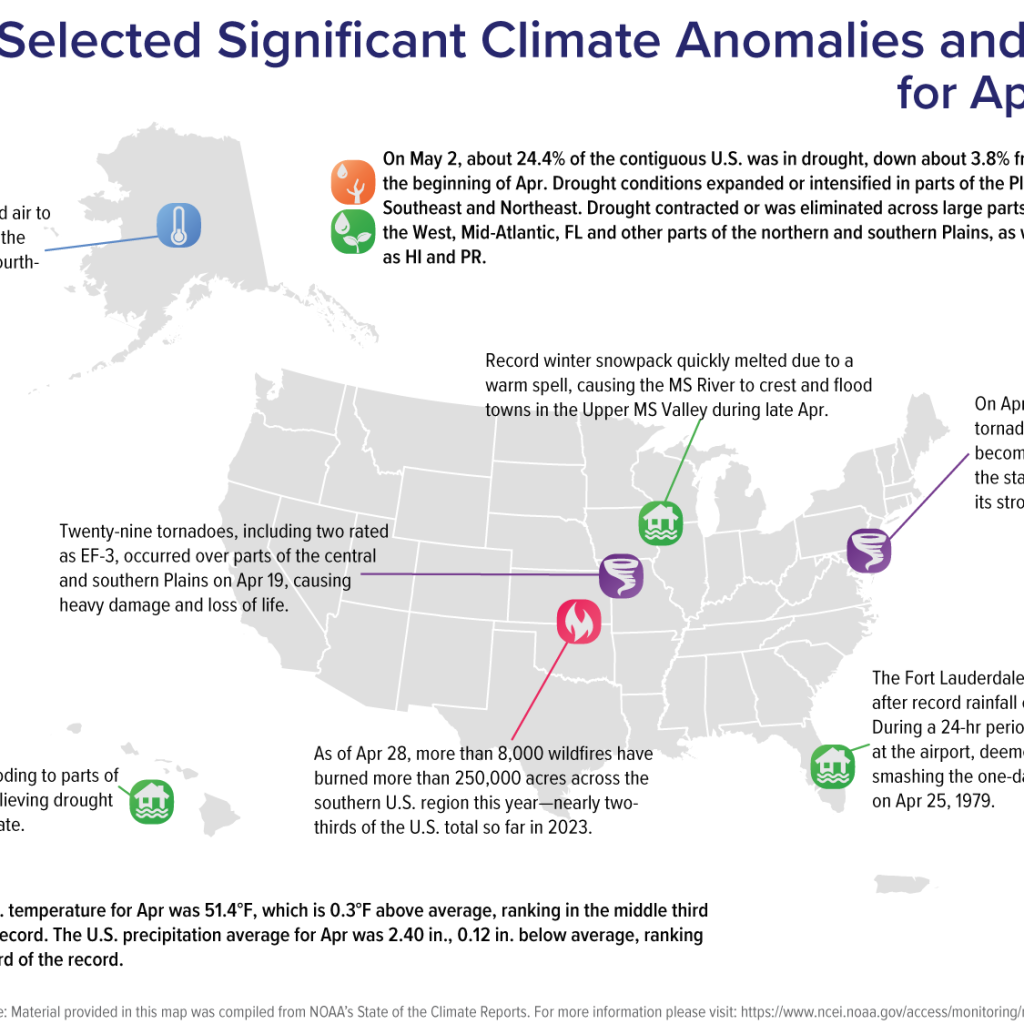
A map of the United States plotted with significant climate events that occurred during April 2023. Image credit: NOAA.
NOAA – So far, 2023 has stood out for the remarkable warmth that covered many parts of the United States, with some states seeing their warmest January to April period on record.
The first four months of the year have also been marked by seven separate billion-dollar disasters that struck the nation, according to scientists from the National Oceanic and Atmospheric Administration’s (NOAA) National Centers for Environmental Information.
The average April temperature across the contiguous U.S. was 10.7 degrees Celsius (0.16 of a degree above the 20th-century average), ranking the month in the middle third of the 129-year climate record.
Maryland and Delaware ranked second warmest on record for April while New Jersey ranked third warmest on record. Connecticut, Florida, Massachusetts, New Hampshire, New York, Pennsylvania, Rhode Island, Vermont and Virginia each saw their top 10 warmest Aprils on record.
Conversely, below-average temperatures covered the Northwest to the central Rockies and northern Plains, as well as parts of the southern Plains. North Dakota ranked 10th coldest on record for the month.
The average precipitation for the month was 61 millimetres — three millimetres below average, which places the month in the middle third of the historical record.
Arizona, Missouri, Nebraska and New Mexico saw their third-to-sixth driest Aprils on record, respectively. Meanwhile, Delaware ranked seventh wettest, North Carolina eighth wettest and New Jersey saw its 10th-wettest April on record.
The average U.S. temperature for the year to date (YTD) was 4.9 degrees Celsius (one degree above average), ranking in the warmest third of the climate record.
Delaware, Florida, Maryland, New Jersey, North Carolina, Pennsylvania and Virginia each had their warmest January to April year-to-date on record. Connecticut, Massachusetts, New Hampshire, New York, Rhode Island, South Carolina and West Virginia each had their second-warmest such YTD, while 14 additional states ranked among their warmest 10 January to April periods on record.
The average precipitation for the first four months of 2023 was 259.6 mm (18.8 mm above normal), ranking in the wettest third of the January to April record.
Wisconsin saw its wettest such YTD on record, while Michigan ranked fourth wettest and Utah ranked seventh wettest. On the dry side, Maryland ranked 13th driest on record for this four-month period.
Through the end of April 2023, the U.S. was struck with seven separate weather and climate disasters, each with losses exceeding US$1 billion, including five severe weather events, a Northeastern winter storm/cold wave and a California flooding event.
The total cost of these events exceeds US$19 billion and resulted in 97 direct and indirect fatalities. The number of billion-dollar disasters so far in 2023 is significant. Only 2017 and 2020 had more during this timeframe, with eight separate disasters recorded in the January to April period.