
Understanding regional climate change is essential
Helps to guide effective climate adaptation policy
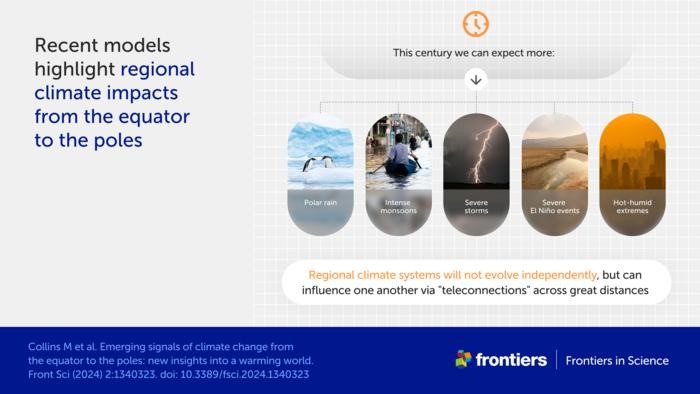
Recent models highlight regional climate impacts from the equator to the poles. (Collins M et al/Frontiers)
Frontiers in Science (WeatherFarm) – The effects of climate change are not distant future scenarios or confined to remote parts of the world — they are unfolding now. In 2023, extreme weather events impacted communities across every inhabited continent, causing major flooding, droughts, and wildfires.
While worldwide changes, such as increases in global mean temperature, often dominate discussions of mitigation actions, a detailed understanding of the regional impacts of a warming world is crucial for protecting communities from escalating risks. A team of researchers writing in Frontiers in Science synthesized results from multiple new studies to provide a clearer picture of these regional climate change impacts.
“We are constantly advancing our understanding of climate change, particularly its regional aspects, to inform policies aimed at adaptation,” said Matthew Collins of the University of Exeter. “While global aspects remain important, humanity will feel the impact of climate change at the regional level. This is where infrastructure planning, extreme event preparedness, and management of public health and food security need to up-to-date climate science.”
The study revealed a range of emerging climate change signals at the local level that are likely to occur this century, spanning from the equator to the poles.
In tropical and subtropical regions, dramatic changes in precipitation are expected to alter monsoon intensity, leading to substantial societal impacts significantly. Monsoon systems, critical for agriculture, directly affect billions of people. Approximately 60 per cent of the world’s population resides in the northern hemisphere monsoon regions, where the summer monsoon season can deliver up to 80 per cent of the annual rainfall. As aerosol emissions decrease and greenhouse gases rise, monsoons are predicted to become more intense, potentially resulting in floods, landslides, and reduced agricultural yields.
In the mid-latitudes, high-resolution climate models indicate a potential strengthening of storm tracks into northwestern Europe, increasing the risk of extreme weather.
“Increased monsoon precipitation and storm track rainfall variability can lead to droughts in some regions and high winds and flooding in others, resulting in devastating impacts on agriculture, essential infrastructure, and the overall health of communities,” said Vikki Thompson, from the Koninklijk Nederlands Meteorologisch Instituut.
In polar regions, projections show that a greater fraction of precipitation will fall as rain rather than snow, potentially accelerating ice melt and amplifying sea-level rise. This transition endangers coastal communities worldwide. Moreover, changes at the poles are not confined to those regions. Polar amplification, which refers to the phenomenon in which the poles warm faster than the rest of the planet, can influence weather patterns in the mid-latitudes, potentially altering storm tracks.
The study calls for a concerted, interdisciplinary effort in the scientific and policy communities to bridge the gaps in climate modeling. Higher-resolution data, integration of machine learning techniques, and new models will improve the simulation of complex climate phenomena at both global and regional levels.
“Regional information is essential for preparing for these extreme events and implementing effective, science-led adaptation measures,” said Matt Priestley, of the University of Exeter. “Without investments into advanced climate modeling and monitoring systems, policymakers and local communities are left navigating climate risks with insufficient information, which can lead to inadequate or misdirected efforts.”