Using artificial intelligence to warn of flooding
May help authorities improve flood evacuation protocols
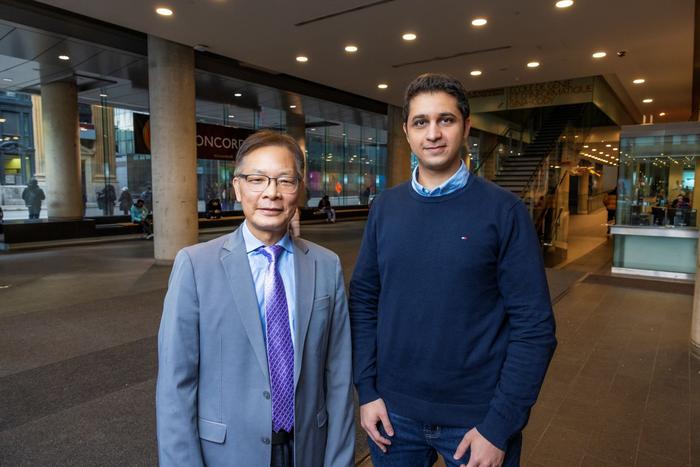
Concordia University Prof. Samuel Li and Ph.d student Mohamed Almetwally Ahmed (Concordia University)
Concordia University, Glacier Farm Media | WeatherFarm – As recent flooding in Spain and elsewhere revealed every minute of warning given to people ahead of a possible flood can save lives and property. A new study may help authorities improve flood evacuation protocols using a machine-learning model developed by Concordia researchers.
Concordia Doctorate of Philosophy student Mohamed Almetwally Ahmed and Prof. Samuel Li created a method that uses artificial intelligence to predict short-term river discharge more accurately.
Using historical data and a novel set of weather-based predictors, they based their research on measuring advection — the rate of water movement — between two hydrometric stations on the Ottawa River. A test case was created using two stations roughly 30 kilometers apart.
Historical data collected over decades by the Canadian government was supplemented by data on rainfall, temperature and humidity levels, among other parameters. Once input into the machine-learning model, these parameters provided reliable estimates on daily discharge and gave real-time data on how much water was moving through a particular cross-section of the river.
“Sub-diurnal forecasting, meaning less than 24 hours, is mainly used for evacuation. This method gives us more accurate forecast probabilities compared to those that make predictions daily or over multiple days,” Ahmed said. “These are all based on probabilities, and the probability increases as the forecasting time decreases.”
The researchers built on an existing type of algorithm called the group method of data handling. This sorted and combined data into groups, where they are computed in different combinations repeatedly until the best and most reliable data combination is identified.
“In this method, we use nine predictors: seven weather parameters and the historical data from two hydroelectric stations. The model ranks and re-sorts these parameters to create multiple combinations until it makes a digital selection of predictors. It is important to note that it does not necessarily use all the predictors or weigh them equally. It uses the ones that prove to be the most accurate,” Ahmed explained.
The model changes depending on time frame. One that predicts discharge 12 hours ahead will be different than one that predicts eight, nine or 10 hours ahead.
The model also changes from river to river. Ahmed conducted additional calculations on data taken from the Boise and Missouri rivers in the United States.
“As this technique matures, we think we will be able to run it in an operational kind of way, where people will be able to check river discharge estimates on their phones, just like they do a weather forecast,” Li said. “Instead of giving them the estimates for temperatures or rainfall at some point in the future, we can give them the water levels.”
To Ahmed, this model is only one tool he hopes authorities can use ahead of disastrous flooding.