Warm, dry weather intensifies U.S. drought
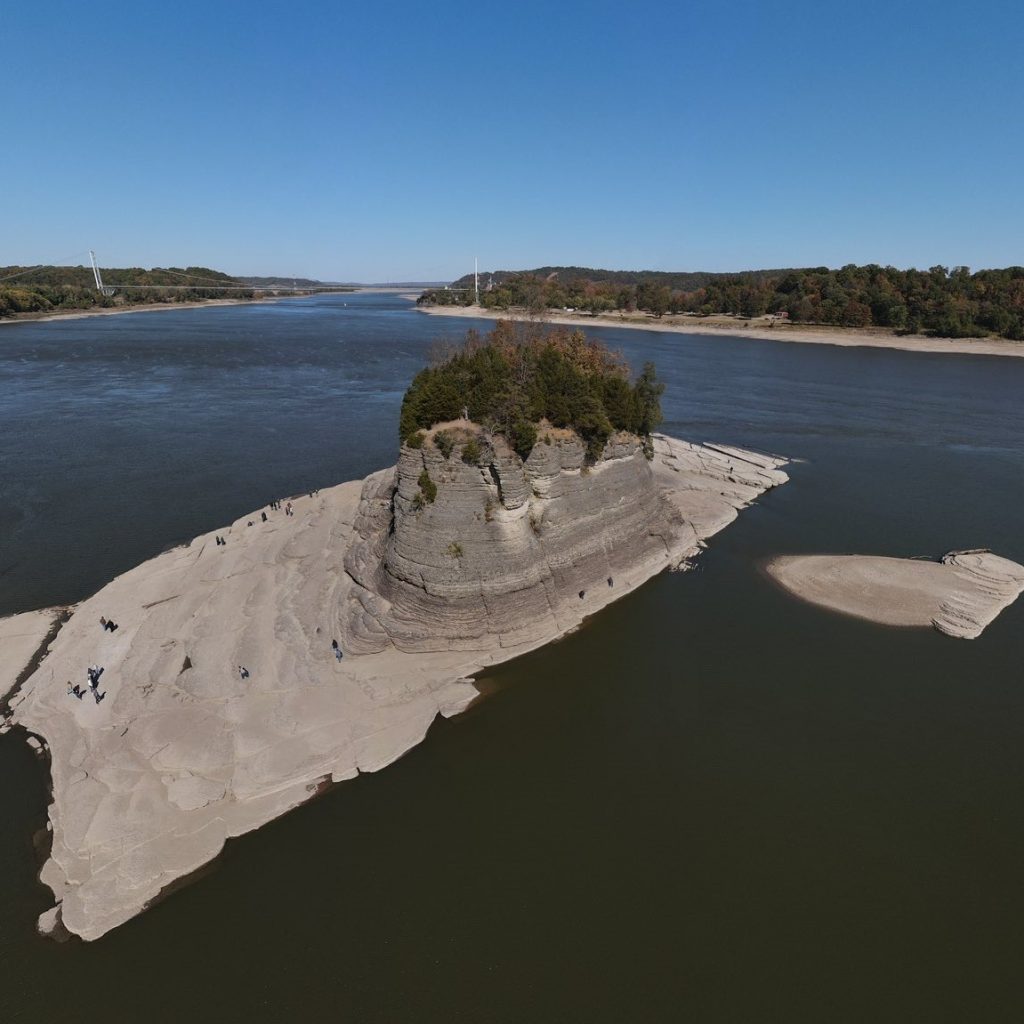
Low river levels around Tower Rock on the Mississippi River at Grand Tower, Illinois. (Reece Streufert/NOAA NWS Paducah)
NOAA – Below-normal rainfall and above-average temperatures intensified drought conditions, broadening the geographic areas of drought across the U.S. in October 2022.
Those dry conditions were also felt along the Mississippi River, where some locations reported their lowest water levels in 10 years.
Here are more highlights from NOAA’s latest monthly U.S. climate report:
The average October temperature across the contiguous U.S. was 55.3 degrees Fahrenheit, 1.2 degrees above the 20th-century average, ranking in the warmest third in the climate record.
Several states had a top-10 warm October. Looking at the western U.S., Washington saw its warmest October on record, Oregon its second warmest, and California its seventh warmest. Along the eastern U.S., Maine had its sixth-warmest October.
The average precipitation was 1.66 inches — half of an inch below average — placing the month in the driest third of Octobers on record.
Florida had its eighth-driest October on record while California and Minnesota each saw their 11th driest. Conversely, an abundance of precipitation during the month gave New Jersey its 10th-wettest October on record.
The average U.S. temperature for the year to date (YTD) was 56.7 degrees F, 1.7 degrees above the 20th-century average, ranking as the 13th-warmest such YTD in the climate record. California saw its third warmest while Oregon saw its sixth warmest.
The U.S. precipitation total for the YTD was 23.19 inches — 2.17 inches below average — ranking as the 15th-driest such YTD on record. California had its driest, Nebraska ranked fourth and Nevada saw its eighth driest on record for this 10-month period.
The Mississippi River dropped to its lowest water levels in a decade near Memphis, Tennessee, and Vicksburg, Mississippi, closing off a vital channel to barge traffic at a crucial time of year for crop transportation. In October 2022, the U.S. Coast Guard reported a total of eight barges that ran aground, along with a long backup of 144 vessels and 2,253 barges trying to access narrow river passages.
Drew Lerner, president of weather forecasting firm World Weather Inc. from Overland Park, Kansas, said that current water levels on the river, as well as the Ohio and lower Missouri Rivers, are lower than normal.
“The barge weight restrictions continue to be in place. So we’re not moving grain like we should. That will continue to be the case over the next few weeks,” he said.
Lerner added that unless there comes a large precipitation event in the U.S. Midwest, there will only be short-term changes to water levels.
“The amount of water that’s needed to bring the rivers up enough to return to normal barge traffic would be very significant,” he explained, estimating one to three inches of rain across all basins. “We have nothing like that on the charts. So we’re going to continue to be drier-biased across the U.S. Midwest (until the end of November) and in the longer range, we’re probably to stay that way until the first quarter of next year.”
According to the U.S. Drought Monitor report released on Nov. 1, about 62.8 per cent of the contiguous U.S. was in drought, up approximately 11.9 per cent from the end of September. Drought conditions expanded or intensified across much of the Southeast and Mississippi, Ohio and Tennessee valleys, and parts of the Plains, central Rockies and Northwest. Drought conditions shrank or were eliminated across portions of the Southwest, southern Plains, Northeast and Hawaii.