
What prehistoric global warming says about future rainfall
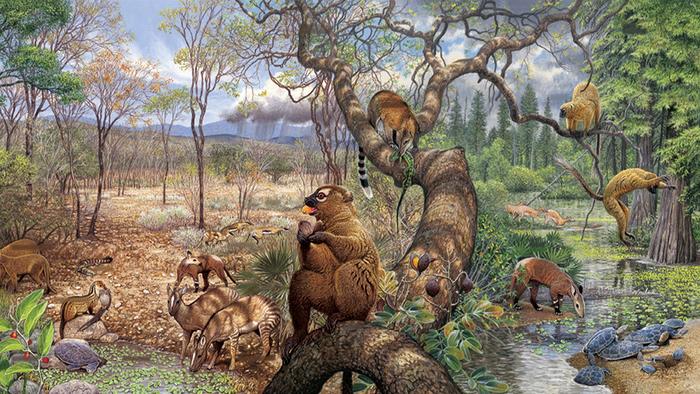
A detail from The Trek Through Time, a 16-plaque diorama at the U.S. Geological Survey’s headquarters in Reston, Va. This painting by Aldo Chiappe depicts the Paleocene Epoch, 66 to 56 million years ago during the early Paleogene Period. (U.S. Geological Survey)
University of Utah (WeatherFarm) – To understand how global warming could influence future climate, scientists looked to the Paleogene Period that began 66 million years ago, covering a time when Earth’s atmospheric carbon dioxide levels were two to four times higher than they are today.
New research by the University of Utah and the Colorado School of Mines reconstructed how rainfall responded to extreme warming during this period using “proxies” left in the geological record in the form of plant fossils, soil chemistry and river deposits. The results challenged the commonly held view that wet places get wetter when the climate warms and drier places become drier, said Thomas Reichler, professor of atmospheric sciences at Utah.
“There are good reasons, physical reasons for that assumption. But now our study was a little bit surprising in the sense that even mid-latitudes regions tended to become drier,” Reichler said. “It has to do with the variability and the distribution of precipitation over time. If there are relatively long dry spells and then in between very wet periods — as in a strongly monsoonal climate — conditions are unfavourable for many types of vegetation.”
Instead of focusing on the amount of precipitation each year, Reichler’s team explored when rain fell and how often. They found rainfall appeared to be much less regular under extreme warming, often occurring in intense downpours separated by prolonged dry spells.
The researchers concluded polar regions were wet, even monsoonal, during the Paleogene, while many mid-latitude and continental interiors became drier overall.
The study looked back to the warmest time in Earth’s history, the early Paleogene, 48 million to 66 million years ago, to understand how rainfall behaves when the planet gets very hot. This period began with the sudden demise of the dinosaurs and saw the rise of mammals in terrestrial ecosystems.
It’s also a period of intense warming culminating in the well-studied event called the Paleocene-Eocene Thermal Maximum(PETM), when levels of heat were 18 degrees Celsius warmer than they were just before humans began releasing greenhouse gas emissions into the atmosphere.
Scientists examined evidence in the geologic record to draw conclusions about ancient climates by looking at plant fossils and ancient soils.
“From the shape and size of fossilized leaves, you can infer aspects of climate of that time because you look at where similar plants exist today with those leaves. So this would be a climate proxy. It’s not direct measurement of temperature or humidity; it’s indirect evidence for climate of that time,” Reichler said.
Another example is the geomorphology of the landscape, such as river channels.
“When there is intermittent, strong precipitation then followed by long periods of drought, that precipitation is forming the riverbed in different ways because there’s very high amounts of water flowing down and carving it out or transporting the rocks much more vigorously than were it a little drizzle every day,” he said.
These reconstructions are inherently uncertain because they rely on indirect evidence rather, Reichler cautioned, but still provide the best available information about how climate operated under extreme warming.
Understanding Earth’s ancient climates enables scientists to better evaluate how well models predict climate behavior under conditions different from the present. Comparisons with paleoclimate model simulations indicated today’s models underestimate how irregular rainfall can become during extreme warming, according to Reichler.
The dry conditions documented in the study were often caused not by less total rainfall, but by shorter wet seasons and longer gaps between rain events. These patterns began millions of years before the PETM and lasted long after, suggesting that once Earth’s climate system crosses certain thresholds, rainfall behavior can change in surprising and complicated ways.
For a warming world, the timing and reliability of rain may matter more than yearly averages, and that has important implications for ecosystems, floods, droughts and water management.