Wildfires accelerate winter snowmelt in Oregon Cascades
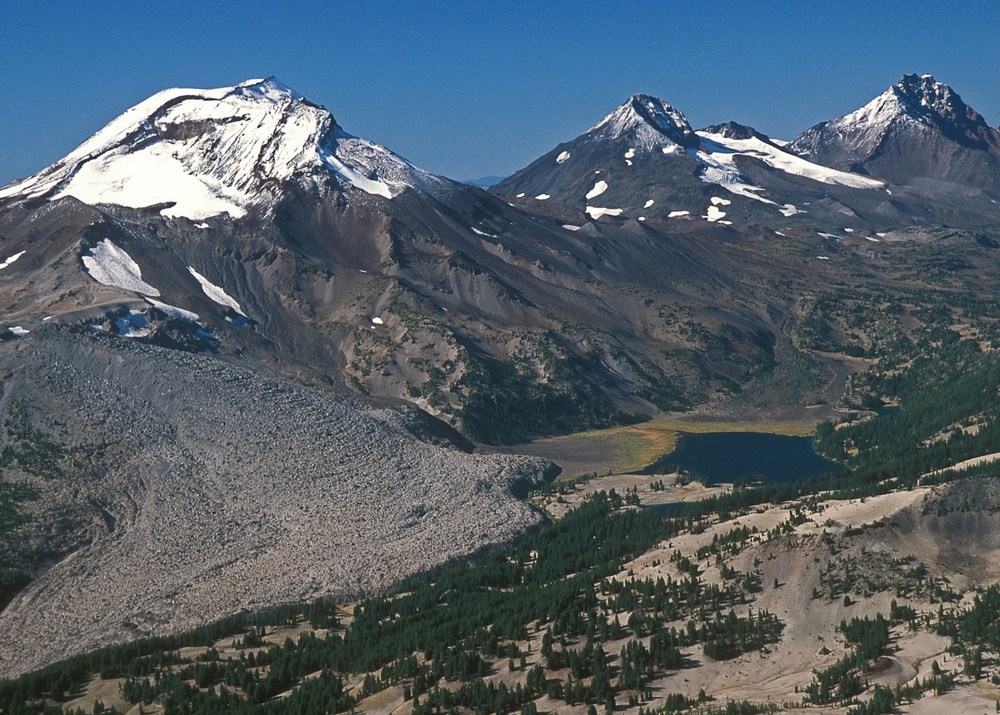
Three Sisters Wilderness Area. (Oregon Encyclopedia)
Portland State University — The Pacific Northwest has seen below-normal snow this season. New research from Portland State University suggested that the region’s snowmelt-dependent water resources could face growing challenges in the years ahead as forest fires and winter rainstorms become more frequent.
Researchers in PSU’s Snow Hydrology Lab, led by Prof. Kelly Gleason, found that snow in burned areas of Oregon’s western Cascades melted much faster during midwinter rain-on-snow events than snow in nearby unburned areas.
Rain-on-snow events, when warm rain falls on an existing snowpack, can trigger rapid melting and increase flood risk downstream in just a matter of days. In the Pacific Northwest, that matters because mountain snow acts as critical seasonal water storage, refilling reservoirs, refreshing municipal and irrigation water supplies, producing hydroelectric power and providing habitat during the drier summer months. The new study shows that wildfire damage can intensify those impacts, reducing how long snow can hold onto water.
Wildfires open forest canopies, allowing more sunlight to reach the snow, while burned debris on the snow surface makes the snow absorb more and reflect less of that light. Together, those changes reduce the snowpack’s “cold content” — the built-in buffer that allows snow to warm up without immediately melting.
Sage Ebel, the study’s lead author, compared that cold content to a sponge.
“If a sponge has a lot of space, it can absorb water before anything drains out,” Ebel said. “But if it’s already saturated, water runs out right away. A snowpack with a lot of cold content can absorb heat before it starts melting. What we’re finding is that small changes in short- and long-wave radiation in the burned sites are keeping that cold content lower than in unburned areas, making them vulnerable to snowmelt during rain-on-snow events.”
Ebel and Gleason installed snow monitoring stations across high, mid and low elevations in the Breitenbush River watershed, 80 per cent of which burned during the 2020 Lionshead fire. In 2023 and 2024, burned sites lost roughly twice as much snow during these rain-on-snow events as nearby unburned areas. Snowpacks at mid-elevations were most vulnerable, with rain-on-snow-driven melt accounting for 26 per cent more of the total annual melt in burned forests.
“The impacts of climate change are exacerbated in the burned forest,” Ebel said. “There’s less capacity to absorb small changes in warming or inputs from rain than in unburned areas. As the area of burned forests increases with climate change, those effects could have widespread consequences for the water reserves we rely on across the West.”
Faster winter melt from burned areas adds new stress to those systems, forcing water managers to balance flood preparedness with long-term water storage in a warming climate.
The researchers said understanding how wildfires and rain-on-snow events interact is essential for refining snowmelt models, improving flood forecasting and planning for more reliable water supplies in the future.