Window to reach climate goals ‘rapidly closing’
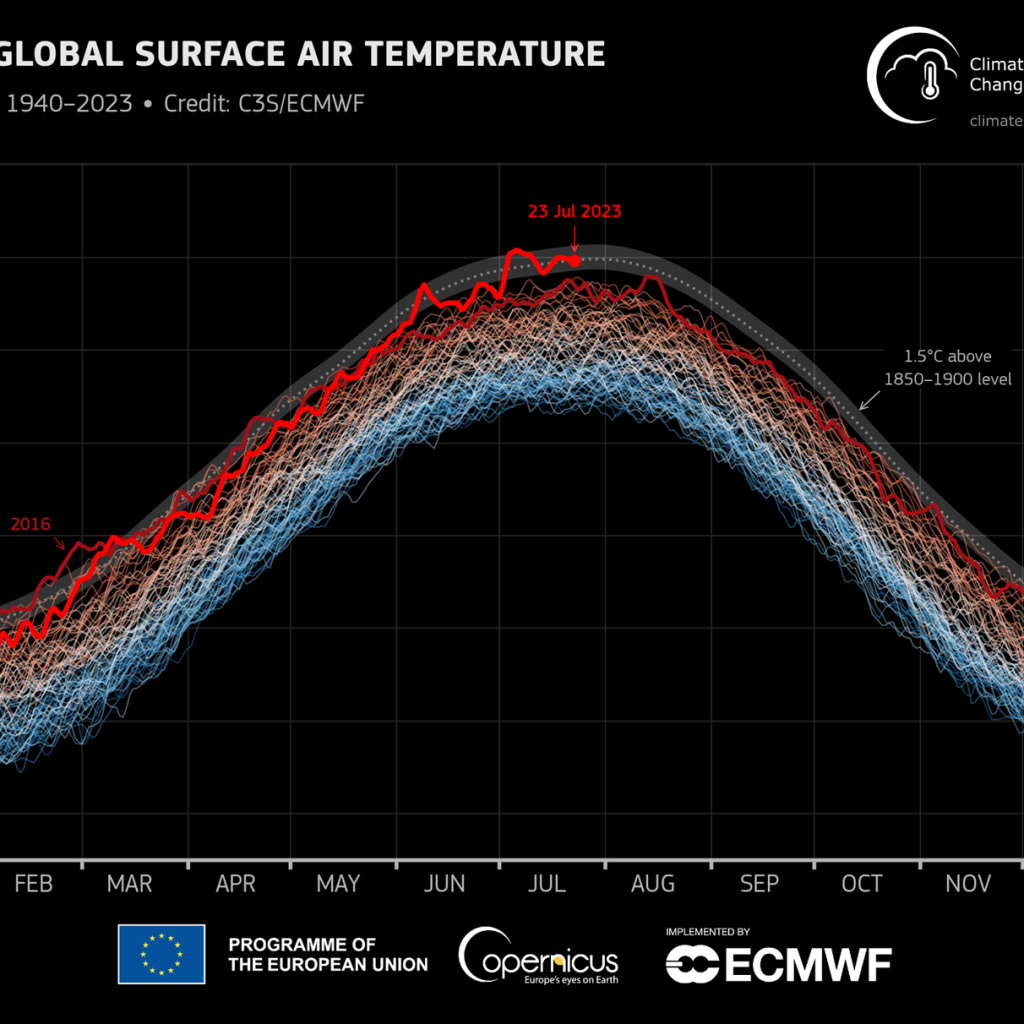
Global daily surface air temperature (°C) from 1 January 1940 to 23 July 2023, plotted as time series for each year. 2023 and 2016 are shown with thick lines shaded in bright red and dark red, respectively. Other years are shown with thin lines and shaded according to the decade, from blue (1940s) to brick red (2020s). The dotted line and grey envelope represent the 1.5°C threshold above preindustrial level (1850–1900) and its uncertainty. Data: ERA5. Credit: C3S/ECMWF.
World Meteorological Organization – The world is not on track to meet the long-term goals set out in the Paris Agreement for limiting global temperature rise, according to a new report from the United Nations Framework for Climate Change (UNFCCC).
Based on the best scientific information, the report summarized 17 key findings from technical deliberations in 2022 and 2023 on the implementation status of the Paris Agreement on climate change and its long-term goals, based on the best scientific information.
UNFCCC Executive Secretary Simon Stiell called for “greater ambition and accelerating action.”
“I urge governments to carefully study the findings of the report and ultimately understand what it means for them and the ambitious action they must take next. It is the same for businesses, communities and other key stakeholders,” he said.
The synthesis report was published ahead of the “global stocktake” at the upcoming UN climate change conference COP28, which will be held in Dubai, United Arab Emirates, in late November.
At the stocktake, delegates will assess if they are collectively making progress towards meeting the climate goals – and where they are not.
Sultan Al Jaber, president-designate of COP28, emphasized the need to disrupt “business as usual” if the Paris Agreement is to be honoured.
For that, emissions must be reduced by 43 per cent by 2030.
“That is why the COP28 Presidency has put forward an ambitious action agenda centred around fast tracking a just and well managed energy transition that leaves no one behind, fixing climate finance, focusing on people lives and livelihoods, and underpinning everything with full inclusivity,” he said.
“I believe we can deliver all of this while creating sustainable economic growth for our people, but we must urgently disrupt business as usual and unite like never before to move from ambition to action and from rhetoric to real results.”
The Paris Agreement committed all countries to limit temperature rises as close as possible to 1.5 degrees Celsius above pre-industrial levels.
A report in May from the World Meteorological Organization (WMO) and the United Kingdom’s Met Office predicted that there is a 98 per cent likelihood that at least one of the next five years will be the warmest on record and a 66 per cent chance of temporarily exceeding 1.5 degrees Celsius above the 1850 to 1900 average for at least one of the five years. This does not mean that we will permanently exceed the 1.5 C level specified in the Paris Agreement which refers to long-term warming over many years.
The average temperature in August – the hottest August and second hottest month on record after July 2023 – is estimated to have been around 1.5 C warmer than the preindustrial average for 1850 to 1900, according to the Copernicus Climate Change Service and its ERA 5 dataset.