
World ice disappearing at faster pace
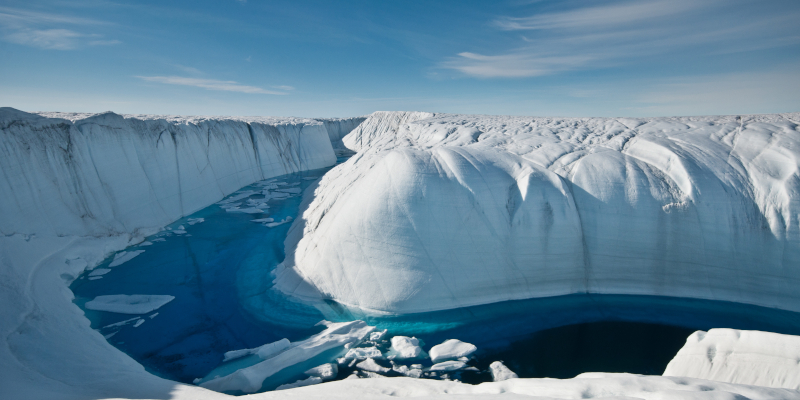
 University of Leeds – The Earth lost 28 trillion tonnes of ice between 1994 and 2017, as the rate at which ice is disappearing across the planet sped up, according to new research led by the University of Leeds.
The lost ice over the reporting period was the equivalent to a sheet of ice 100 metres thick covering the whole of the United Kingdom.
The rate of ice loss from the Earth has increased markedly within the past three decades, from 0.8 trillion tonnes per year in the 1990s to 1.3 trillion tonnes per year by 2017.
Ice melt across the globe raises sea levels, increases the risk of flooding to coastal communities, and threatens to wipe out natural habitats which wildlife depend on.
The findings of the research team, which includes the University of Edinburgh, University College London and data science specialists Earthwave, were published in European Geosciences Union’s journal The Cryosphere.
Funded by the U.K. Natural Environment Research Council, the research shows that overall, there has been a 65 per cent increase in the rate of ice loss over the 23-year survey. This has been mainly driven by steep rises in losses from the polar ice sheets in Antarctica and Greenland.
“Although every region we studied lost ice, losses from the Antarctic and Greenland ice sheets have accelerated the most,” said lead author Dr. Thomas Slater, a Research Fellow at Leeds’ Centre for Polar Observation and Modelling.
“The ice sheets are now following the worst-case climate warming scenarios set out by the Intergovernmental Panel on Climate Change. Sea-level rise on this scale will have very serious impacts on coastal communities this century,” added Slater.
The study was the first of its kind to examine all the ice that is disappearing on Earth, using satellite observations .
“Over the past three decades there’s been a huge international effort to understand what’s happening to individual components in Earth’s ice system, revolutionised by satellites which allow us to routinely monitor the vast and inhospitable regions where ice can be found,” said Slater.
The survey covered 215,000 mountain glaciers spread around the planet, the polar ice sheets in Greenland and Antarctica, the ice shelves floating around Antarctica, and sea ice drifting in the Arctic and Southern Oceans.
Rising atmospheric temperatures have been the main driver of the decline in Arctic sea ice and mountain glaciers across the globe, while rising ocean temperatures have increased the melting of the Antarctic ice sheet. For the Greenland ice sheet and Antarctic ice shelves, ice losses have been triggered by a combination of rising ocean and atmospheric temperatures.